New Car-kit Standard
Having qualified in early February, it fell upon me to check that everything in the kits at work was in-date. Simple answer: a resounding 'NO'!
Having attended to that, it was brought to my attention that there is also a travel kit in every company car which needed to be checked. (That was the theory, slightly flawed.)
The cost of replacing all the 'perishables' in each kit was about fifteen pounds (per kit). Cost of a new kit: twelve pounds! No maths required - I ordered five kits.
A week after they arrived came the announcement: BS 8559-2:2014 - the new British Standard for travel kits!
I didn't have the gall to order replacement replacements. A slightly-different kit is better than none.
Here's a side-by-side comparison. Left is the new 'motor vehicle' standard, right 'travel':
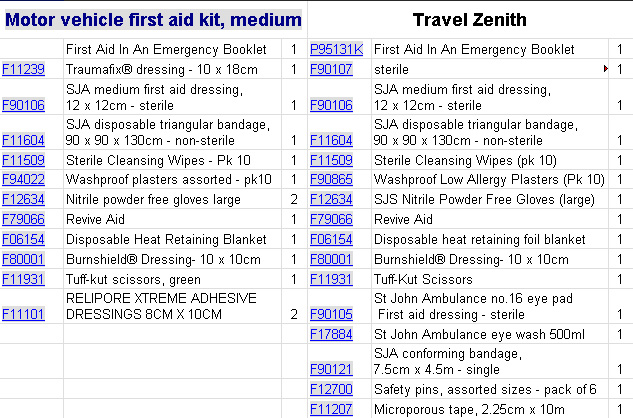
In fine, you gain two dressings and a pair of gloves, but lose a bandage, eye wash and pad, and some fixings, for 40p less. Or buy a bigger one.
I added a couple of eyewash pods (and a Relipore dressing) to each.
The Point of All This?
I'm not sure that there is a UK law requiring every private vehicle to have a first aid kit, but I think anyone driving
to (some?) European countries needs one, so I expect all new cars will include one.
Whether BS8559 equates to DIN13164 is another matter entirely.
Company cars fall under the 'at work' requirements, otherwise you probably don't need to worry about updating - expiry dates permitting.
As I found, it was cheaper to get whole new kits than piecemeal renewals. Alternatively you might prefer to grab a Motoring Refill Kit and re-stock your old box/bag.
Not Only, But Also . . .
Viewers in Scotland can obtain BSI compliant kits more locally. Even if they opt for independance, the British Standard will remain good advice!
Also, Wallace Cameron have a travel/vehicle range. They claim compliance but one BS8599-2 kit has a part number including 'BS8599-1'. Maybe an old photo.
And they have a Refill Kit too.