Plasters
The commonest item in first aid kits (perhaps because they're flat, and fit in even the smallest), plasters (aka adhesive dressings) are probably overlooked in their complexity.
The standard type supplied with most kits is the 'washproof'. This is plastic-backed, sometimes perforated, and often uses 'latex free' adhesive.
I used one on a toe the other day and found the 'plasticky' texture uncomfortable against the adjacent toes. I expect I wouldn't have noticed it on a (relatively) flat area like a forearm.
Another problem with plastic is that it's sometimes stiff, and won't shape itself readily to awkward areas.
In contrast the humble fabric plaster is soft, flexible and sticks very well - an advantage until you want to remove it!
(I also like the smell, but that's not a strong consideration when choosing a dressing.)
A Tale of Two Glues
(I thought 'A Tale of Two Stickies' would be . . . tacky?)
The glue used on 'normal' fabric plasters is latex based (also called rubber-based). It's strong, reasonably water-resistant (I recently wore one in the shower - it was fine) . . . and causes an allergic reaction in a lot of people.
Generally the 'low allergy washproof' types use a non-latex adhesive which, depending on quality, is often also non-stick!
Irksomely St. John used to stock nice waterproof ones with a transparent backing, which were comfortable and stuck well.
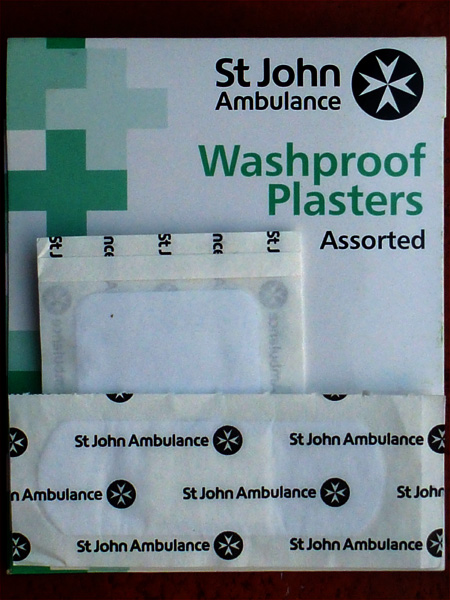
(The ones pictured above went out of date in late 2011.)
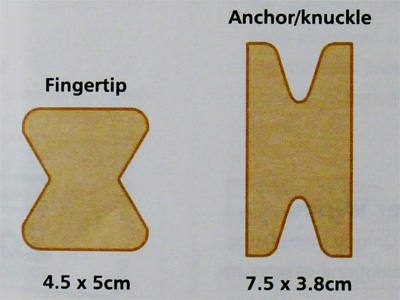
I've just re-stocked a couple of kits from a large fabric assortment pack. I chose it because, in addition to different sizes, it also has some of the shaped finger-end (bowtie) and 'anchor' ones (for across a knuckle or between the fingers).
If faced with an allergy sufferer I'll have to use a dressing, or a sterile swab and microporous tape.
And More?
Some manufacturers are developing 'advanced dressings', like the Savlon Blister Plasters. These 'hydrocolloid' plasters keep the injury moist, and should be kept on for several days.
In contrast the dry types should be changed daily. I try to let the wound air for half an hour, or until the soggy white skin dries back to normal, before applying a new one.